
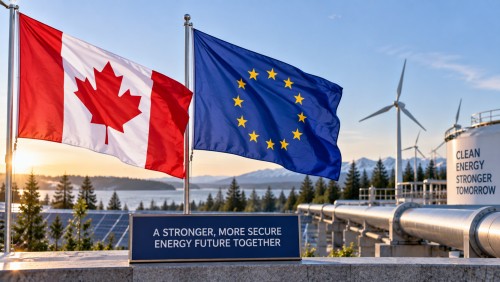
Canada and the European Union are considering a new energy partnership aimed at enhancing Europe’s energy security and lessening its dependence on Russian energy sources. This development was discussed during Canadian Prime Minister Mark Carney’s recent visit to Strasbourg, where he engaged with EU leaders on strengthening economic and strategic connections.
Canada is well-positioned for this potential alliance due to its substantial oil and natural gas reserves and its export facilities on the West Coast. However, the lack of similar infrastructure on the eastern coast poses a challenge for direct energy shipments to Europe, with new development expected to take several years.
One innovative approach being explored is the implementation of energy swap agreements. These arrangements would allow Canadian energy cargoes initially bound for Asian markets to be exchanged with shipments destined for Europe, thus enabling European buyers to access Canadian energy without direct transatlantic transport.
The proposed partnership is not limited to fossil fuels. Canada’s ability to supply critical minerals essential for Europe’s clean-energy transition is also under consideration. This would support renewable energy development and other low-carbon technologies, further integrating energy trade with clean-energy innovation.
As they seek to solidify their economic and energy ties, Canada and the EU’s cooperation could encompass a broad spectrum of energy-related initiatives, including fossil fuels, critical minerals, and sustainable energy solutions.