
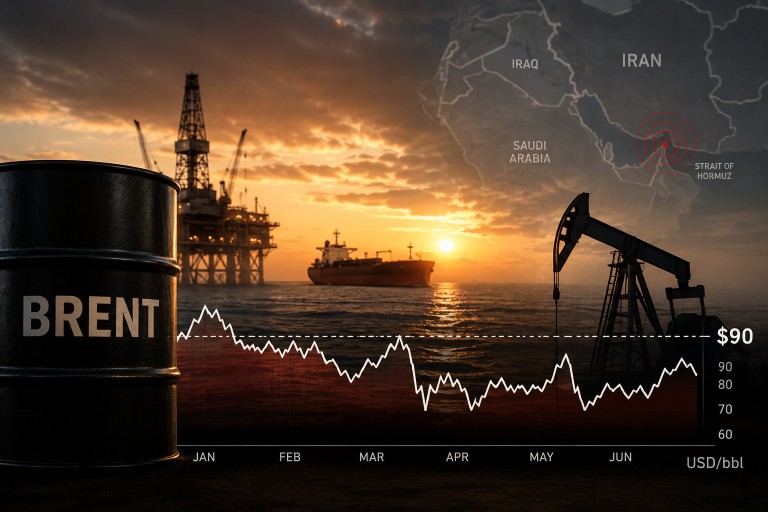
Brent crude oil is facing challenges in breaching the $90 per barrel mark, even after experiencing its largest weekly increase since April. Although it traded close to $85 on Friday and marked an 11% rise over the week, the global benchmark’s ascent is hindered by a lack of prolonged disruption in the Strait of Hormuz and the absence of clear signs of tightening global supply. Meanwhile, the U.S. benchmark, West Texas Intermediate, was nearing $80 per barrel. The recent surge in oil prices is attributed to renewed military tensions between the U.S. and Iran, which have affected Middle Eastern supply routes and slowed tanker traffic through the Strait of Hormuz, a critical passage for about 20% of the world’s oil flows.
Despite these tensions, Brent crude has struggled to surpass a peak of $87.55 per barrel reached earlier this week. Analysts suggest that the market remains optimistic about the potential for diplomatic resolutions, which has kept oil prices from climbing further. Investors are keeping a close watch on global oil inventories, looking for sharp declines that could indicate a supply shortage, as well as monitoring the situation at the Strait of Hormuz to see if disruptions become more prolonged.
While military confrontations have escalated, oil markets have shown relative stability, with Brent crude trading within a narrow band in recent days. This stability reflects a broader expectation among investors that the tensions will not escalate further. Nonetheless, the Strait of Hormuz remains a focal point for energy markets, as tanker traffic has decreased and exporters seek alternative routes to lessen their reliance on this strategic waterway.
The repercussions of these disruptions extend beyond crude oil prices. In the United States, refining margins have increased due to tighter supplies of diesel and gasoline. European fuel markets are exhibiting similar strains, exacerbated by reduced Russian fuel exports, which add additional pressure to global energy supplies.
Market participants are now concentrating on two critical developments: the potential for a significant drop in oil inventories signaling a supply shortage, and the outcome of diplomatic efforts to resolve the military tensions. Until one of these scenarios unfolds, analysts anticipate that Brent crude prices will remain below the $90 threshold, despite the ongoing geopolitical risks.